

US Air Force: Unidentified Anomalous Phenomena Reporting Classified
US Air Force: Unidentified Anomalous Phenomena Reporting Classified
The National Air & Space Intelligence Center, mandated to analyze reporting of UAP from across the defense & intelligence communities, cites harm to ‘national security’ as reason for obfuscation.

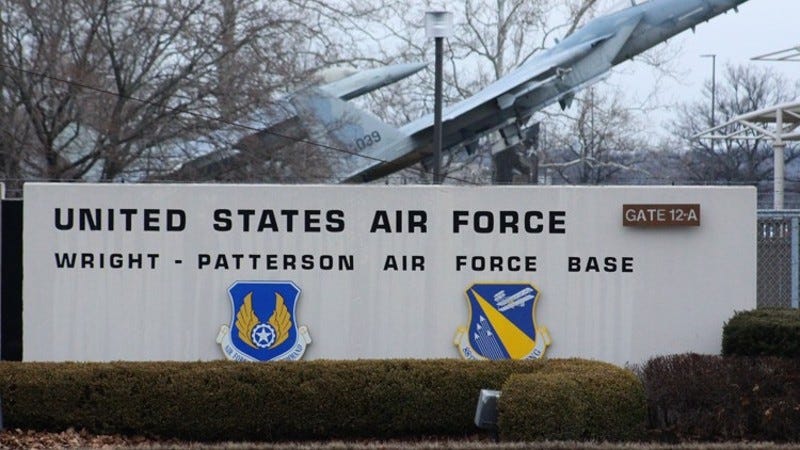
The National Air and Space Intelligence Center (NASIC), located at storied Wright Patterson Air Force Base in Ohio — once the home of the United States Air Force’s Project Blue Book investigation into unidentified flying objects throughout the 1950s and 1960s—was mandated by Congress in March of this year to intake and analyze all manner of data on unidentified anomalous phenomena (UAP) in response to repeated incursions by unexplained objects that at times exhibit extraordinary capabilities within military training ranges and other sensitive airspace.
Now, like their counterparts in the Navy, the Air Force—which has perhaps the longest and most controversial relationship with UAP given its over fifty-year history of investigating these anomalous phenomena—has closed the door to any more recent data being released to the public.
In response to a Freedom of Information Act request filed by the UAPR this year seeking videos and other responsive material pertaining to UAP, the NASIC responded that any and all documentation on UAP submitted by Air Force personnel to the NASIC is classified and “could reasonably be expected to cause damage to national security,” if released to the public in whole or in part.
The UAPR has since filed an appeal in response to the Air Force’s decision.
“To maintain operations security and to avoid disclosing information that may be useful to our adversaries, the Department of Defense (DoD) does not discuss publicly the details of either the observations or the examination of reported incursions into our training ranges or designated airspace, including those incursions initially designated as UAP,” wrote DoD spokesperson Susan Gough in an emailed statement.
“We are developing a means to provide updates to the public when we successfully resolve a UAP report and move it from the ‘unidentified’ to the ‘identified’ category,” Gough continued. “Often the observed UAP, meaning the phenomena itself, is not a security concern; however, the source or method used to capture the unidentified phenomena might be sensitive.”
Since 2003, the NASIC has been tasked with analyzing intelligence on foreign forces operating in air and space domains. Part of this field operating agency’s approximately 4,100-strong force was also charged by Congress in March with examining UAP data from US intelligence and defense sectors, as required by the Intelligence Authorization Act for fiscal year 2022. The Pentagon’s recently-formed UAP office, called the All-domain Anomaly Resolution Office (AARO), is also tasked with the intake and analysis of UAP data from various offices and agencies of the federal government.
Curiously, Air Force Secretary Frank Kendall does not seem concerned about the national security threat unidentified anomalous phenomena themselves may pose, even if the military branch believes releasing data on such phenomena could harm the United States.
When asked by an anchor on CBS Mornings on September 8 whether UAP may be a threat to the Air Force and national security, Sec. Kendall responded bluntly: “To be quite honest, not for me. I have real threats that I worry about every day, severe threats.”

While some in the Pentagon seem unconcerned with potential hazards posed by UAP, others — principally those actually encountering them regularly, as well as some in Congress—see the phenomena as a legitimate flight safety issue.
Lt. Ryan Graves, a former F/A-18 Super Hornet pilot, expressed his apparent frustration about the potential danger posed by UAP often exhibiting extraordinary flight capabilities and appearing in restricted airspace, in an interview with a former DoD appointee and State Department official, Marik von Rennenkampff:
“Unsurprisingly, Graves takes the Pentagon’s foot-dragging on UFOs seriously — and personally. ‘I lost about a friend a year on average while I was in the Navy. … This is a dangerous business. To think that we’re adding more danger for no reason is outlandish,’ Graves told me.
“For Graves, eight years of relative government inaction since his squadron’s 2014 near-collision ‘is unacceptable. It’s a demonstration of ignoring the needs of their operators. That’s the bottom line.’”
Some in defense and intelligence circles disagree not only with the Pentagon’s lack of urgency regarding aviator safety, but with the Air Force’s lack of transparency, and believe that a more nuanced approach to public disclosure is needed.
“I don’t think this is a reasonable response,” Christopher Mellon, a former Deputy Assistant Secretary of Defense for Intelligence in the Clinton and George W. Bush administrations, and a former Staff Director of the United States Senate Select Committee on Intelligence told the UAPR. “There is certainly a lot of information from sensitive sources that need to be protected. However, the Air Force Office of Special Investigations [looked into] the videos that I brought to the New York Times and the Washington Post and said there was no damage to our security. Not only was there no damage, they advanced national security because they helped us identify a strategic vulnerability. So it's hard for me to understand now why they're saying that other similar information can't be released on grounds of national security. There is a legitimate issue.”
Mellon also contends that the military’s use of Executive Order 13526 to classify UAP data in blanket fashion is an abuse of the Order itself, because 13526 “restricts reclassifying information and also prohibits information from being inappropriately classified,” he wrote in March. “It’s difficult to see how [UAP videos, for example] could ‘reasonably be expected to cause identifiable or describable damage to the national security.”
Mellon has accused the Air Force of having a long-running culture of resistance to oversight on the issue of UAP.
In a piece for The Debrief in February titled “Why is the Air Force AWOL on the UAP Issue?”, he compared the Department of the Navy’s UAP data contributions to the Office of Director of National Intelligence’s (ODNI) Congressionally-mandated Preliminary Report: Unidentified Aerial Phenomena, with the Air Force’s apparent refusal to cooperate with the review. Mellon alleges that of the 144 reported UAP incidents cited in the ODNI’s June 2021 report, none or almost none of those reports came from the Air Force:
“This chasm between Navy candor and Air Force reticence is not the result of using different radar systems or monitoring different regions,” wrote Mellon. “It appears to be little more than the Air Force brass resisting civilian oversight of the UAP issue.”
He also asserted that because of the Air Force’s massive array of surveillance measures including ground-based and space-based radar systems, “the Air Force and its component organizations actually detected thousands of UAP from 2004 through 2021,” he continued. “Admittedly, it is theoretically conceivable that none represented breakthrough Russian or Chinese technology—much less alien spacecraft—but the point is that we simply don’t know. That’s what makes them UAP.”
Despite mounting Congressional interest in UAP, including the first public hearing on the topic in over 50 years, the Air Force continues to evade scrutiny. Its long and tangled history with the UAP issue continues, however, shrouded in as much mystery and obfuscation as perhaps it has ever been.
“Since I left ATIC [the Air Technical Intelligence Center at Wright Patterson, a precursor to the NASIC], the UFOs haven’t gone away and neither has the interest,” wrote Captain Edward J. Ruppelt, who led the Air Force’s Project Blue Book investigation into UAP for over two years, in his 1956 book. “There hasn’t been too much in the newspapers about them because of the Air Force’s current policy of silence, but [UAP are] with us.”